Zema | Ethiopia | 250g
Or save up to 10% with regular delivery


Description
Zema — Single Origin 100% Arabica | Ethiopia, Sidamo
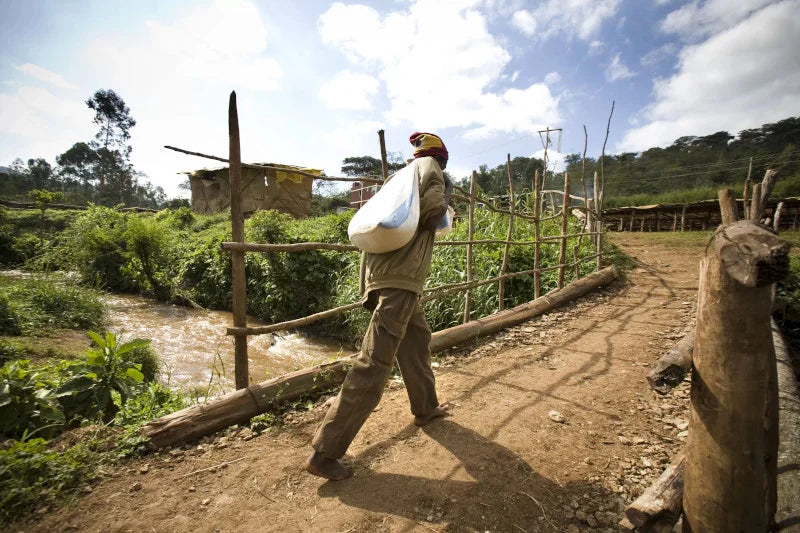
One coffee, one origin, revealing its full character with every sip. Grown in Ethiopia's Sidamo region at 1,800 metres above sea level. Hand-picked, selecting only ripe cherries, then washed-processed.
Tasting notes: opens with a lively bergamot acidity, unfolds into red berries, apricot and milk chocolate, and finishes with floral notes. Bitterness: zero.
Perfect for you if: you love fresh, aromatic, delicate coffees.
Technical sheet
- Tasting notes: citrus, flowers, fruit and milk chocolate
- Body: 1/3
- Sweetness: 1/3
- Bitterness: 0/3
- Acidity: 3/3
- Roast: medium-light
- Origin: Ethiopia
- Location: Sidamo region
- Altitude: 1800m+ above sea level
- Harvest: hand-picked
- Processing: washed
- Species: Arabica
Thanks to our medium or medium-light roast, carefully selected green beans can truly shine, releasing all their natural aromas without ever tasting too bitter. Try it without sugar too – you'll be amazed!
The coffee is packed in a sealed bag fitted with a one-way valve, which lets the coffee degas while keeping out the oxygen that would oxidise it. This keeps your coffee fresh and aromatic for months.
Notes:
- Roasted as whole beans (then ground)
- 250g / 1000g net weight
Coffee Story
Today we travel to Ethiopia, the native home of the magical roasted bean.
The discovery
The coffee plant was first discovered in the south of the country, in the Kaffa region, growing wild among the forest trees.
Legend has it:
"Thousands upon thousands of years ago, a goatherd from the Kaffa highlands of Ethiopia named Kaldi noticed that his goats, besides being more stubborn and headstrong than usual, were also very jumpy: they took fright at the slightest thing and charged head-down at anyone who came near. The whole herd was restless, with constant clashing of horns. But what seemed even more serious to the goatherd was that, come evening, when he drove the goats back into their pens, the animals were still agitated and wouldn't rest. In the middle of the night they were all still wide awake.
Unable to make sense of this strange behaviour, the goatherd from the Ethiopian highlands went to a monastery and told his story to a wise old monk, who asked whether he had recently changed pastures and whether the goats had perhaps been nibbling on some plant they weren't used to."
In one of the earliest versions of the legend, brought to Europe by Naironi in 1671, we find the theme of the new "drug" being at first rejected and condemned by the authorities of the day:
"Kaldi, noticing the stimulating effect on his flock as they nibbled the bright red berries of a glossy green shrub, tried chewing the fruit himself. His excitement persuaded him to take the berries to an Islamic holy man at a monastery. But the holy man condemned their use and threw them into the fire, from which an enticing aroma arose. The roasted beans were quickly raked from the embers, crushed and dissolved in hot water, making the very first cup of coffee."
And so we discovered the potential of these aromatic beans.
In Ethiopia coffee has always had a sacred meaning, becoming an essential part of the economy, politics, rituals and language… in short, of the country's entire way of life.
Indeed, as well as making up two-thirds of the country's earnings, it has given rise to important, historic and above all fascinating rituals and ceremonies.
The coffee ceremony
The Ethiopian coffee ceremony follows a precise ritual that places great importance on conversation and human connection.
It takes place three times a day, led by the woman of the house dressed in white with colourful borders, who serves three rounds of coffee to each guest – and each round has its own meaning.
The beans are roasted in a perforated pan over an open flame, kept constantly moving by the same woman. The browned beans are then ground and left to steep in the traditional coffee pot.
Watching coffee being made this way, with such care, calm and attention, is moving – and it shows how, in our Italian culture, we sometimes take it for granted and don't give it the attention it deserves when we taste it.
Turning it back into a true ritual on special occasions lets us enjoy the moment as one of pure flavour, peace, calm and pleasure.
Coffee-growing area
In Ethiopia, coffee is truly considered a small miracle of nature: there are no large plantations here, but rather the work of countless smallholders and local families who often grow the plants in their own "garden" – around 12 million of these small producers.
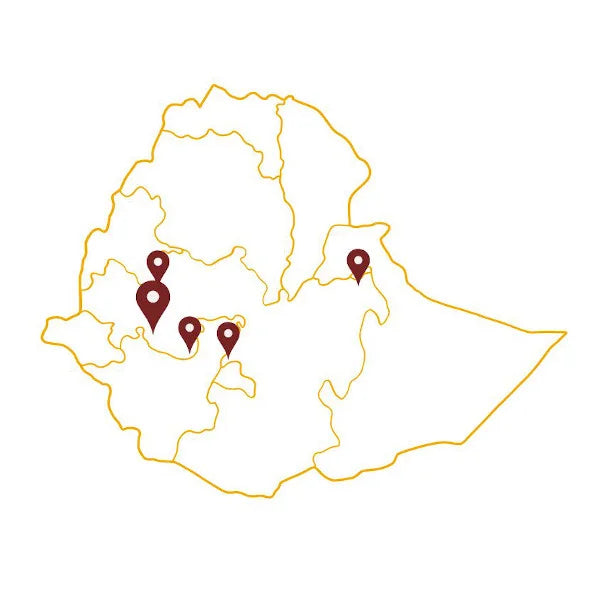
These are usually found in:
- Sidamo, in the south of the country – where our single origin comes from – which produces exceptional coffees with a pronounced acidity and includes the Yirgacheffe and Guji areas;
- Harrar, the driest, almost desert-like part of the country, where one of the oldest varieties is grown: Ethiopian Harrar;
- Limu and Djimmah, in the west of the country, where washed coffees are called Limu and natural ones Djimmah.
The coffee usually grows at 1500–1800 metres, sometimes reaching as high as 2200–2400 metres.
Because it's all so small-scale, growers don't use chemicals or substances that harm the environment, leaving the soil pure and free to breathe, and growing their coffee in the shade of other crops and tall trees.
All this makes Ethiopian coffees among the finest in the world, with aromatic, intense, defect-free beans.
On the palate they offer fresh, delicate aromas of citrus, red berries and flowers, alongside spicier notes or hints of chocolate and dried fruit. Their sweet notes are often likened to honey and caramel.
Did you know?
Ethiopian proverbs and sayings about coffee:
"Buna dabo naw", meaning "Coffee is our bread!", a reminder of how important coffee is in their lives;
"Buna teto", meaning "Drink coffee", used to say "Good luck" or "It will all work out".